Ancient Egyptians believed in second life, Reward and Punishment
We will sail here in their history and symbols to try to find out what's the story about every one of them.
The myth of Ancient Greece has a very interesting story about human existence, with iconic gods and goddesses who controlled the destiny of the mortals.Let's try to sail in their stories and try to live the drama which was created be Greek minds.
People worshipped many different gods in ancient China. Some of these gods have been worshipped since the Shang Dynasty (about 2000 BC). Others became popular later on..
Showing posts with label Clash of Gods Series. Show all posts
Showing posts with label Clash of Gods Series. Show all posts
In the 11th century, chronicler Adam of Bremen records in his Gesta Hammaburgensis Ecclesiae Pontificum that a statue of Thor, who Adam describes as "mightiest", sits in the Temple at Uppsala in the center of a triple throne (flanked by Woden and "Fricco") located in Gamla Uppsala, Sweden. Adam details that "Thor, they reckon, rules the sky; he governs thunder and lightning, winds and storms, fine weather and fertility" and that "Thor, with his mace, looks like Jupiter". Adam details that the people of Uppsala had appointed priests to each of the gods, and that the priests were to offer up sacrifices. In Thor's case, he continues, these sacrifices were done when plague or famine threatened. Earlier in the same work, Adam relays that in 1030 an English preacher, Wulfred, was lynched by assembled Germanic pagans for "profaning" a representation of Thor.
Two objects with runic inscriptions invoking Thor date from the 11th century, one from England and one from Sweden. The first, the Canterbury Charm from Canterbury, England, calls upon Thor to heal a wound by banishing a thurs. The second, the Kvinneby amulet, invokes protection by both Thor and his hammer.
Now let's watch the episode about Thor
This Episode is not about mythology of one past civilizations. It's about a combination of many civilizations mythology. Tolkin worlds became very popular and it named according to John Ronald Reuel (J. R. R. Tolkien).
John Ronald Reuel Tolkien is CBE was an English writer, poet, philologist, and university professor, best known as the author of the classic high fantasy works The Hobbit, The Lord of the Rings, and The Silmarillion.
Now let's watch the episode about Tolkin's Monsters
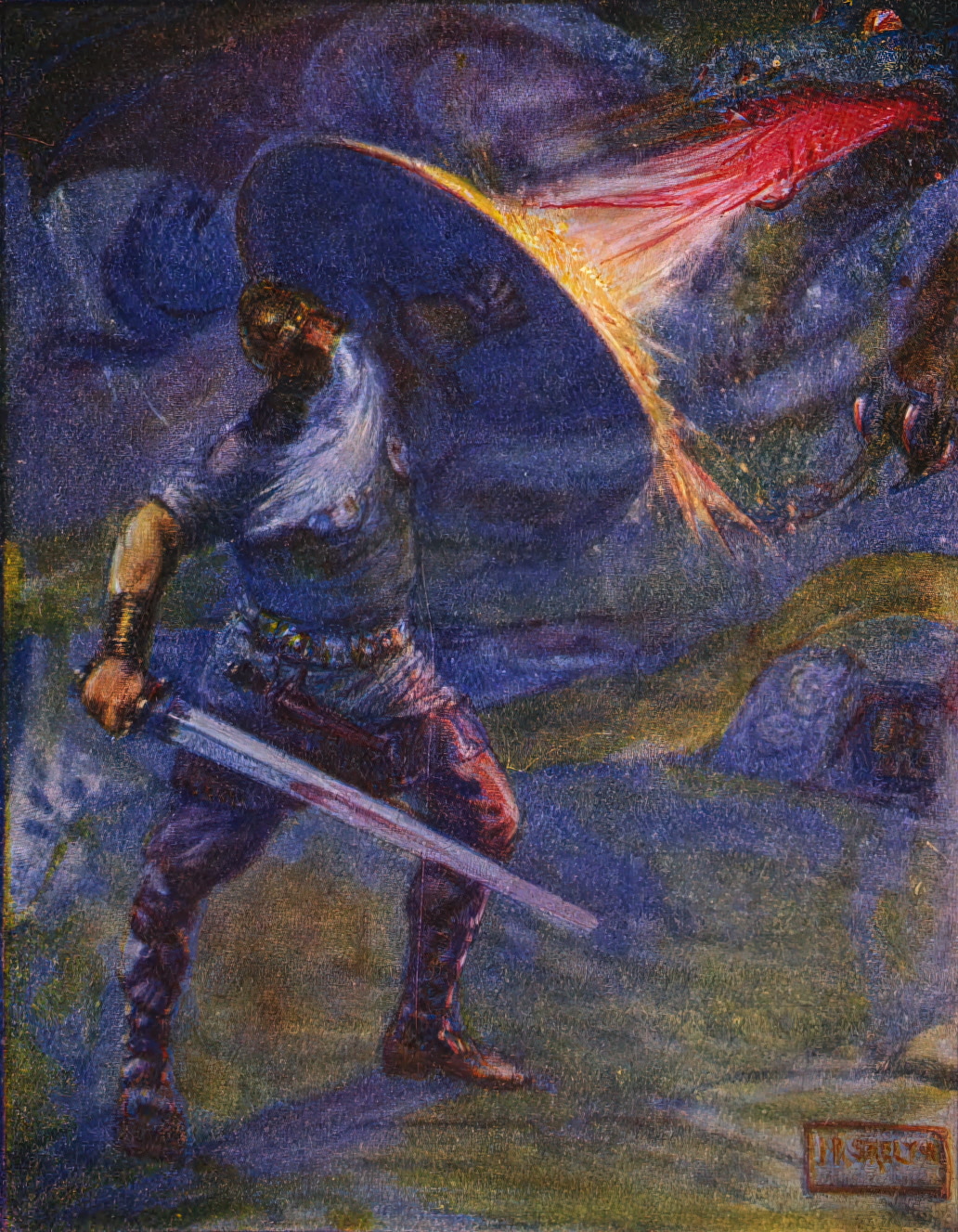
The main protagonist, Beowulf, a hero of the Geats, comes to the aid of Hroðgar, the king of the Danes, whose great hall, Heorot, is plagued by the monster Grendel. Beowulf kills Grendel with his bare hands and Grendel's mother with a sword of a giant that he found in her lair.
Later in his life, Beowulf is himself king of the Geats, and finds his realm terrorised by a dragon whose treasure had been stolen from his hoard in a burial mound. He attacks the dragon with the help of his thegns or servants, but they do not succeed. Beowulf decides to follow the dragon into its lair, at Earnanæs, but only his young Swedish relative Wiglaf dares join him along with Tinshaw. Beowulf finally slays the dragon, but is mortally wounded. He is buried in a tumulus or burial mound, by the sea.
Beowulf is considered an epic poem in that the main character is a hero who travels great distances to prove his strength at impossible odds against supernatural demons and beasts. The poem also begins in medias res ("into the middle of affairs") or simply, "in the middle", which is a characteristic of the epics of antiquity. Although the poem begins with Beowulf's arrival, Grendel's attacks have been an ongoing event. An elaborate history of characters and their lineages is spoken of, as well as their interactions with each other, debts owed and repaid, and deeds of valour.
Homer's Iliad and Odyssey portrayed Odysseus as a culture hero, but the Romans, who believed themselves the heirs of Prince Aeneas of Troy, considered him a villainous falsifier. In Virgil's Aeneid, he is constantly referred to as "cruel Odysseus" (Latin "dirus Ulixes") or "deceitful Odysseus" ("pellacis", "fandi fictor"). Turnus, in Aeneid ix, reproaches the Trojan Ascanius with images of rugged, forthright Latin virtues, declaring (in John Dryden's translation), "You shall not find the sons of Atreus here, nor need the frauds of sly Ulysses fear." While the Greeks admired his cunning and deceit, these qualities did not recommend themselves to the Romans who possessed a rigid sense of honour. In Euripides's tragedy Iphigenia at Aulis, having convinced Agamemnon to consent to the sacrifice of his daughter, Iphigenia, to appease the goddess Artemis, Odysseus facilitates the immolation by telling her mother, Clytemnestra, that the girl is to be wed to Achilles. His attempts to avoid his sacred oath to defend Menelaus and Helen offended Roman notions of duty; the many stratagems and tricks that he employed to get his way offended Roman notions of honour
Homer's Iliad and Odyssey portrayed Odysseus as a culture hero, but the Romans, who believed themselves the heirs of Prince Aeneas of Troy, considered him a villainous falsifier. In Virgil's Aeneid, he is constantly referred to as "cruel Odysseus" (Latin "dirus Ulixes") or "deceitful Odysseus" ("pellacis", "fandi fictor"). Turnus, in Aeneid ix, reproaches the Trojan Ascanius with images of rugged, forthright Latin virtues, declaring (in John Dryden's translation), "You shall not find the sons of Atreus here, nor need the frauds of sly Ulysses fear." While the Greeks admired his cunning and deceit, these qualities did not recommend themselves to the Romans who possessed a rigid sense of honour. In Euripides's tragedy Iphigenia at Aulis, having convinced Agamemnon to consent to the sacrifice of his daughter, Iphigenia, to appease the goddess Artemis, Odysseus facilitates the immolation by telling her mother, Clytemnestra, that the girl is to be wed to Achilles. His attempts to avoid his sacred oath to defend Menelaus and Helen offended Roman notions of duty; the many stratagems and tricks that he employed to get his way offended Roman notions of honour.
The three Gorgon sisters—Medusa, Stheno, and Euryale—were all children of the ancient marine deities Phorcys (or Phorkys) and his sister Ceto (or Keto), chthonic monsters from an archaic world. Their genealogy is shared with other sisters, the Graeae, as in Aeschylus's Prometheus Bound, which places both trinities of sisters far off "on Kisthene's dreadful plain":
Near them their sisters three, the Gorgons, winged
With snakes for hair— hated of mortal man—
While ancient Greek vase-painters and relief carvers imagined Medusa and her sisters as beings born of monstrous form, sculptors and vase-painters of the fifth century began to envisage her as being beautiful as well as terrifying. In an ode written in 490 BC Pindar already speaks of "fair-cheeked Medusa".
In a late version of the Medusa myth, related by the Roman poet Ovid (Metamorphoses 4.770), Medusa was originally a ravishingly beautiful maiden, "the jealous aspiration of many suitors," priestess in Athena's temple, but when she was caught being raped by the "Lord of the Sea" Poseidon in Athena's temple, the enraged Athena transformed Medusa's beautiful hair to serpents and made her face so terrible to behold that the mere sight of it would turn onlookers to stone. In Ovid's telling, Perseus describes Medusa's punishment by Minerva (Athena) as just and well earned.
In most versions of the story, she was beheaded by the hero Perseus, who was sent to fetch her head by King Polydectes of Seriphus. In his conquest, he received a mirrored shield from Athena, gold, winged sandals from Hermes, a sword from Hephaestus and Hades' helm of invisibility. Medusa was the only one of the three Gorgons who was mortal, so Perseus was able to slay her while looking at the reflection from the mirrored shield he received from Athena. During that time, Medusa was pregnant by Poseidon. When Perseus beheaded her, Pegasus, a winged horse, and Chrysaor, a golden sword-wielding giant, sprang from her body.
Before he ascended the throne of Crete, Minos struggled with his brothers for the right to rule. Minos prayed to Poseidon to send him a snow-white bull, as a sign of approval by the gods for his reign. He promised to sacrifice the bull as an offering, and as a symbol of subservience. A beautiful white bull rose from the sea, but when Minos saw it, he coveted it for himself. He assumed that Poseidon would not mind, so he kept it and sacrificed the best specimen from his herd instead. When Poseidon learned about the deceit, he made Pasipha, Minos' wife, fall madly in love with the bull. She had Daedalus, the famous architect, make a wooden cow for her. Pasipha climbed into the decoy and fooled the white bull. The offspring of their lovemaking was a monster called the Minotaur.
The creature had the head and tail of a bull on the body of a man. It caused such terror and destruction on Crete that Daedalus was summoned again, but this time by Minos himself. He ordered the architect to build a gigantic, intricate labyrinth from which escape would be impossible. The Minotaur was captured and locked in the labyrinth. Every year for nine years, seven youths and maidens came as tribute from Athens. These young people were also locked in the labyrinth for the Minotaur to feast upon.
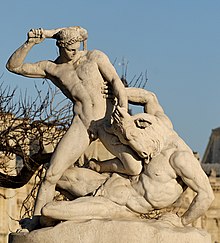
When the Greek heroTheseus reached Athens, he learned of the Minotaur and the sacrifices, and wanted to end this. He volunteered to go to Crete as one of the victims. Upon his arrival in Crete, he metAriadne, Minos's daughter, who fell in love with him. She promised she would provide the means to escape from the maze if he agreed to marry her. When Theseus did, she gave him a simple ball of thread, which he was to fasten close to the entrance of the maze. He made his way through the maze, while unwinding the thread, and he stumbled upon the sleeping Minotaur. He beat it to death and led the others back to the entrance by following the thread